The sculpture
The Great Cave's carvings
Who is who in the Great Cave at Elephanta: the three-faced Shiva, Ardhanarishvara, Gangadhara, the wedding panel and the others, from published sources.
See Elephanta dates ↗Quick answer
The Great Cave at Elephanta is a pillared hall whose walls carry large relief panels of Shiva: the three-faced bust on the south wall, Ardhanarishvara, Gangadhara, a wedding scene, Ravana shaking Mount Kailasa, Shiva killing Andhaka, Nataraja and Yogishvara. A square linga shrine stands at the western end. Heights and positions below come from the Archaeological Survey of India and Wikipedia.
The three-faced Shiva
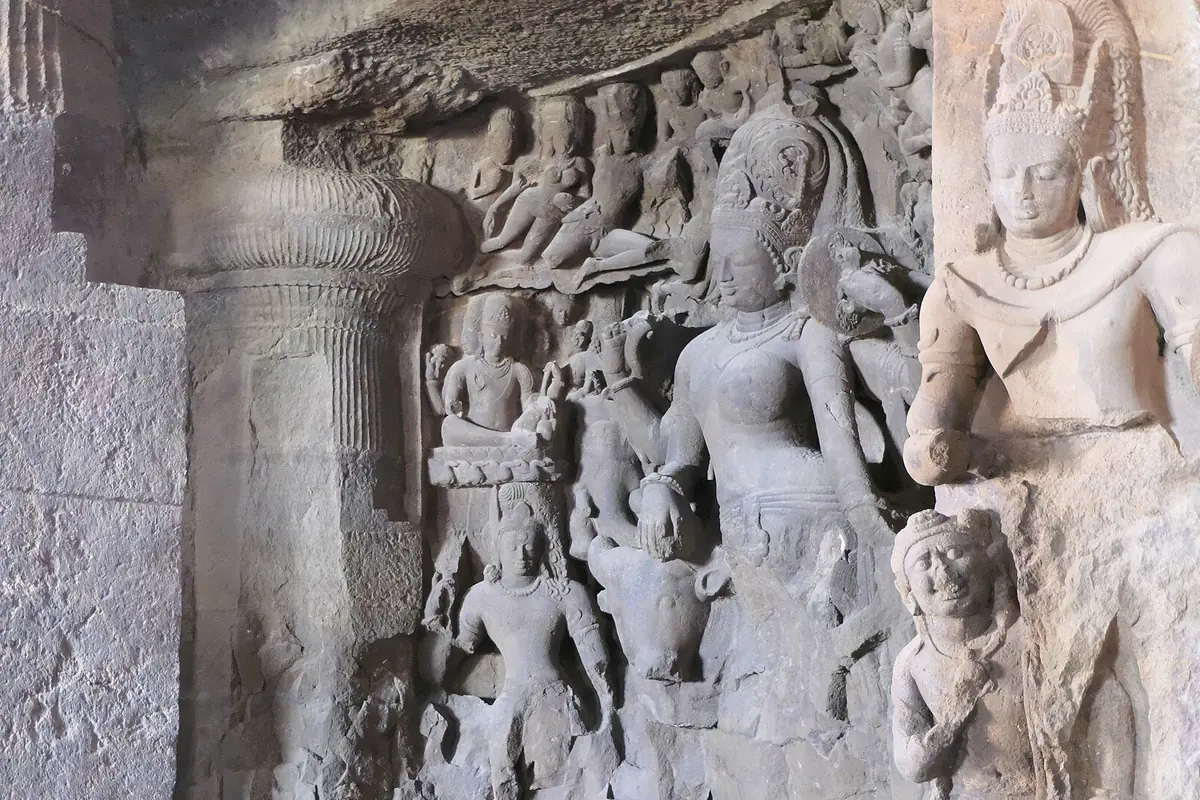
The best-known carving is a colossal bust of Shiva with three faces, called the Trimurti, Sadashiva or Maheshamurti, set in a central recess on the south wall. The Archaeological Survey of India describes it as a bust of three forms of Shiva, and says the central recess is one of three large recesses with guardian figures. Wikipedia gives its height as 5.45 metres.
Ardhanarishvara
On the east side of the cave stands Ardhanarishvara, a figure that joins Shiva and Parvati in a single body, half male and half female. Wikipedia describes it as a four-armed carving about 5.11 metres high. The Archaeological Survey of India lists it among the cave's main panels. It is worth a pause because the two halves are worked into one standing figure.
Gangadhara
Gangadhara shows Shiva bringing the river Ganges down to earth. Wikipedia gives the panel as about 4 metres wide and just over 5 metres high. It is one of the large panels of the cave, and like the others it is worn, so a guide can point out what is missing as well as what remains.
The wedding of Shiva and Parvati
The Kalyanasundara panel shows the wedding of Shiva and Parvati. Wikipedia places it on the south-west wall, near the linga shrine, and the Archaeological Survey of India lists it among the cave's main panels. It is cut into the rock as one scene among the cave's many, so the hall holds quiet moments as well as dramatic ones.
Ravana, Andhaka and the dancing Shiva
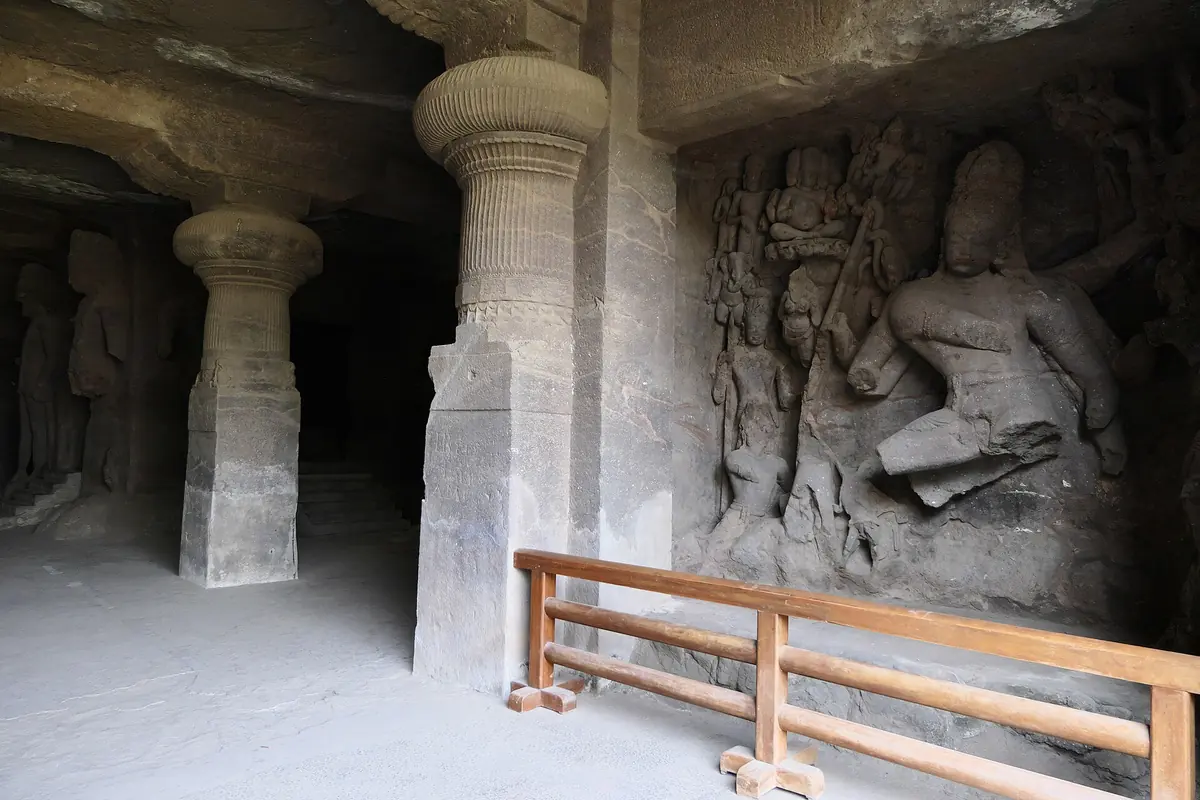
Ravana trying to lift Mount Kailasa fills the north-east corner, according to Wikipedia. Shiva as Bhairava killing the demon Andhaka is about 3.5 metres high. Nataraja, Shiva as lord of dance, has eight arms and is about 4 metres wide; Wikipedia places it on the west side of the portico, while Yogishvara, Shiva as lord of yoga seated in padmasana, is on the east side. These panels are the more dramatic ones, full of movement against the calm of the three-faced bust.
The linga shrine
At the western end of the hall stands a free-standing square shrine, a cella with an entrance on each of its four sides. Wikipedia says each entrance is flanked by two guardian figures, eight in all, each about 4.6 metres tall, and that the linga sits on a raised platform reached by six steps. The shrine can be seen from anywhere in the cave. It is the ritual centre of the hall, and the carved panels are arranged around it.
How the cave is laid out
Wikipedia gives the Great Cave's hall as about 39.63 metres square, with a main entrance on the north side and openings to the east and west. Pillars divide the space into a grid, and George Michell, cited there, reads the layout as a mandala. The Archaeological Survey of India says the plan resembles the Dumar Lena cave at Ellora. Knowing the layout helps you find the large panels, which sit on the walls around the shrine.
Who this isn't for
Anyone wanting every panel labelled and lit will be frustrated, because the sculpture is worn and the hall is a working monument rather than a gallery. Wikipedia reports that accounts differ on the damage: Portuguese soldiers are said to have used the caves as a firing range, and the island was later restored. If you prefer finished, intact art, a museum may suit you better. If you like old stone that has lost parts of itself, the cave is the point.
Frequently asked questions
What is the three-faced Shiva called?
It is called the Trimurti, Sadashiva or Maheshamurti. It is a colossal bust of Shiva cut into the south wall of the Great Cave.
How tall is the three-faced Shiva?
Wikipedia gives its height as 5.45 metres, about 18 feet.
What is Ardhanarishvara?
A form of Shiva joined with Parvati in one body, half male and half female. At Elephanta it is a four-armed carving about 5.11 metres high.
What is in the shrine at the western end?
A free-standing square shrine with a linga and an entrance on each side. Eight guardian figures flank the doors.
Are all the panels intact?
No. Many are worn and have lost figures, and sources differ on how the damage happened.
Sources